Personalized Plastic Gift Cards That Combine Durability with Style

What Are Personalized Plastic Gift Cards?
Near the register of most retail stores, restaurants, and salons across Canada sits a small display of plastic cards. They are easy to pass by without much thought. Still, businesses reorder them season after season for a simple reason. Customers buy them, hold onto them, and return to use them later. That repeat visit matters. It keeps traffic moving through the door.
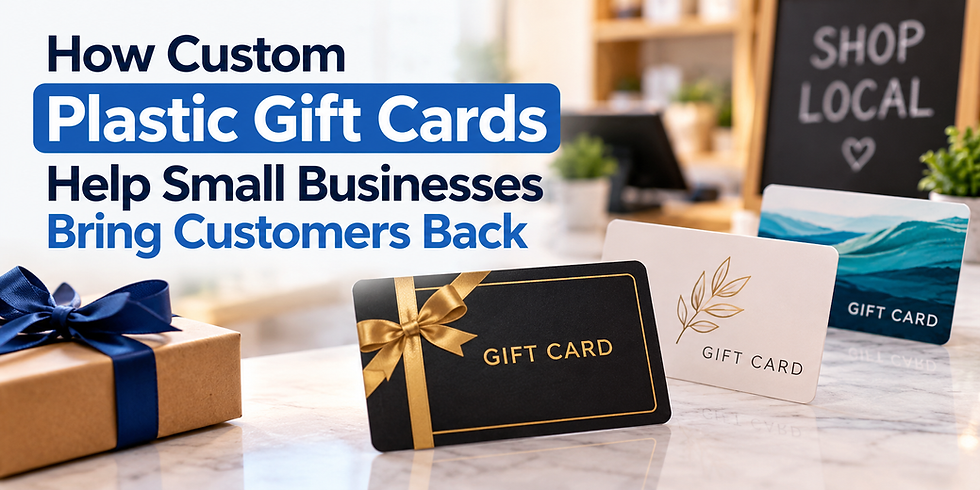
Personalized plastic gift cards in Canada are typically printed on PVC or composite plastic and carry a business's name, logo, color palette, and a stored dollar value or loyalty balance. The plastic construction is what separates them from traditional paper gift certificates. A paper voucher can tear, absorb moisture, or fade after time in a wallet or purse. A plastic card handles daily wear far better and remains readable at the point of sale. Customers tend to treat the card more like a payment card than a coupon, and that small shift in perception often leads to more confident spending.
The physical size follows an established industry standard used throughout Canada and internationally. A typical card measures 3.375 inches by 2.125 inches, with a thickness of about 0.030 inches. That matches the format used for debit and credit cards issued by Canadian financial institutions, so it fits neatly into any wallet without bending or extra handling. Retailers and service providers usually place orders in batches tied to seasonal promotions, holiday demand, loyalty program launches, or store openings. The format has remained consistent for decades because the convenience is practical, familiar, and reliable.
The Role of Material in Card Longevity
The material a card is made from determines how long it stays functional, and not every plastic card is built the same way.
Most gift cards start with PVC, polyvinyl chloride, as the base. PVC resists moisture, stays flexible across normal temperature ranges, and holds printed ink without significant fading. Manufacturers that want a more rigid card layer, PVC with a polyester core, which increases scratch resistance and keeps the card from developing the slight bend that comes with repeated handling over time.
Printing method matters just as much as material. Cards produced through offset lithography or commercial digital printing, then finished with a laminate overlay, last considerably longer than cards run through standard inkjet equipment. The laminate does several things at once. It locks in the color, keeps surface moisture from working into the card, reduces fingerprint transfer, and creates a physical barrier against the kind of abrasion that comes from sliding in and out of a wallet slot daily.
Under normal use, a well-produced custom plastic gift card stays functional for two to five years. That range matters most for businesses running loyalty programs where customers are expected to carry the same card for multiple years. A card that degrades and stops scanning after eighteen months creates a support problem, a replacement cost, and a moment where the customer loses confidence in the program itself.
Design Elements That Define Custom Plastic Gift Cards
A customer sees the card before they think about what is on it. The design is the first thing the card communicates, and custom plastic gift cards give businesses more control over that first impression than most other physical marketing materials.
Color and Branding
Color accuracy is an area where small differences become visible at the wrong moments. Brand colors can be matched using the Pantone Matching System, a standardized reference that gives printers across different facilities a shared target for reproducing specific shades. Without that reference, colors shift between vendors and between print runs. A card that comes back slightly wrong in hue sits next to shopping bags, packaging, and signage from the same brand every time a customer pulls it out, and those inconsistencies add up over time.
Finish Options
Three surface finishes cover most of what businesses ask for. Gloss is reflective, giving colors a sharp and saturated look under most lighting. Matte absorbs light rather than reflecting it, which produces a quieter appearance that reads as more restrained. Soft touch has a texture closer to suede than to traditional plastic. It is different enough that people notice it when they first handle the card, which can work in favor of brands that want the physical card to feel considered rather than generic.
Spot UV coating sits alongside those base finishes rather than replacing them. It is applied to specific areas of the design, creating contrast between a glossy treatment on part of the surface and a matte background beneath it. Logos and text treated this way pick up light differently from the rest of the card, which adds depth without changing the overall color or feel.
Special Features
Beyond flat surfaces, some printers offer finishing options that add dimension to the card. Foil stamping presses a thin metallic layer into selected areas of the artwork. Gold and silver are the most common choices, though other metallic tones are available from some suppliers. Embossing raises specific areas of the card surface so they can be felt as well as seen, which is a technique used most often on logos or card numbers. Die cutting produces cards in shapes other than the standard rectangle, which a smaller number of brands use to make the card itself part of the visual identity.
These options extend production time and add to the per-card cost. They tend to make more practical sense for limited edition runs, premium membership cards, or seasonal programs than for large-volume everyday gift card programs.
Functional Technology in Personalized Plastic Cards
The design handles how the card is received. The technology built into it handles how it actually gets used at the point of sale.
Magnetic Stripes
The magnetic stripe is the most familiar piece of card technology, and it remains the most common encoding method for gift cards. Data is stored across three tracks on the stripe. When a staff member swipes the card through a reader, the reader pulls that data and connects to the merchant's system to check the balance and complete the transaction. Magnetic stripes are low-cost and compatible with a wide range of card readers. Their main vulnerability is exposure to strong magnetic fields, which can degrade or erase the stored data. Certain phone cases and some retail security equipment can cause this if the card is stored or placed near them regularly.
Barcodes and QR Codes
A barcode or QR code on the card's surface gives a point-of-sale scanner another path to read the card without a physical swipe. QR codes have seen wider adoption in recent years, partly because a smartphone camera can read them without dedicated scanning hardware. Retail environments where staff use tablets or phones at the register can process QR code gift cards without adding a separate card reader to the setup. For businesses running a mix of fixed registers and mobile checkout points, QR codes offer practical flexibility that a magnetic stripe alone does not.
RFID and NFC Chips
A chip embedded in the card body communicates with a reader wirelessly. RFID chips, which use radio frequency identification, operate at a short range and appear most often in access control settings like hotel room keys or employee access cards. NFC chips, which use near field communication, operate at a very short range, under four centimeters, and support contactless payment transactions. The customer taps the card on the reader, and the system processes the transaction without swiping or scanning anything. For gift card programs where the customer experience at the register matters; NFC-capable cards are a reasonable option to compare against standard magnetic stripe cards when selecting a supplier.
Ordering and Production Considerations
Ordering a batch of cards involves several practical decisions before a single card gets produced. Getting these right at the start saves time and avoids the kind of back and forth that pushes delivery dates past the window a business was planning around.
Minimum Order Quantities
Commercial printers typically require a minimum order of 250 to 500 cards per run. Below that number, setup costs make the per-card rate impractical for most budgets. Businesses that need a small initial quantity sometimes order a larger batch and hold the remainder in storage, especially when the card design does not include dates, prices, or other details that will change. That approach spreads setup costs across a larger print run and leaves cards on hand for future campaigns without requiring a new order.
Artwork Requirements
Files submitted for print need to be in vector format. Adobe Illustrator and EPS files are the standard. All text in the design should be converted to outlines before submission so that the file does not depend on the printer having the same fonts installed. Photographic elements in the artwork need to be at least 300 dots per inch at the final card size. Images that look sharp on a screen at 72 dots per inch often print with visible softness or pixelation, which is a problem that does not surface until the proof comes back. Printers provide a bleed template with each order that shows how far the artwork needs to extend past the card's cut edges. Submitting artwork without bleed is one of the most common reasons first submissions are rejected and sent back for revision.
Production Timelines
After artwork is approved, most print runs take between seven and fifteen business days to complete. Rush production is available through some suppliers, though it costs more, and not all finishing options are available on a rush schedule. Businesses that are planning around a fixed date, a holiday campaign, a store opening, or a loyalty program launch need to count backward from that date and build in time for artwork revisions, which almost always take at least one round of back and forth.
How Perfect Plastic Cards Serves This Market
Perfect Plastic Cards produces personalized plastic gift cards for businesses in retail, hospitality, and service industries. The company prints in full color, supports multiple surface finishes, and handles magnetic stripe encoding, barcode printing, and QR code integration. Each production run goes through a quality review before shipping. Businesses with questions about file requirements or card specifications, contact the production team through the company's website.
Practical Uses Across Industries
Gift cards built on personalized plastic show up across most consumer-facing industries. How each sector uses them depends on what the card is expected to do beyond just holding a balance.
Retail: Clothing stores, bookshops, and specialty retailers use gift cards to let customers prepay for future purchases. The card also functions as a reason to return to the store. Customers who receive a gift card and come in to use it often spend more than the card's stored value, which makes the card worth more to the business than its face amount alone.
Food and Beverage: Restaurants and cafes issue branded gift cards for birthdays, holidays, and corporate gifting. The card sits in someone's wallet, carrying the restaurant's design until the next visit. That passive presence is something a paper certificate does not replicate.
Health and Wellness: Spas, salons, and fitness studios use personalized plastic cards for membership programs and prepaid service packages. In these settings, the card does two jobs. It processes payment, and it serves as a membership credential that staff recognize on sight, removing the need for a separate membership document.
Corporate Gifting: Companies buy custom plastic gift cards in volume for employee recognition programs and client gifts. The cards are redeemable at a selected retailer or within the company's own service network. A branded card communicates something a generic gift envelope does not, which is that the sender put thought into the format of the gift, not just its dollar amount.
Summary
Personalized plastic gift cards serve a clear function for businesses that need a physical stored-value product. The cards are made to last; they carry functional encoding that connects to existing point of sale systems, and they can be produced with design specifications that match a brand's existing visual standards. The practical details, material choice, finish, encoding method, artwork format, and order timing each affect the quality and usability of the finished card. Across retail, food service, wellness, and corporate gifting, personalized plastic cards continue to be a reliable tool for businesses that want to give customers something worth keeping.


Comments